
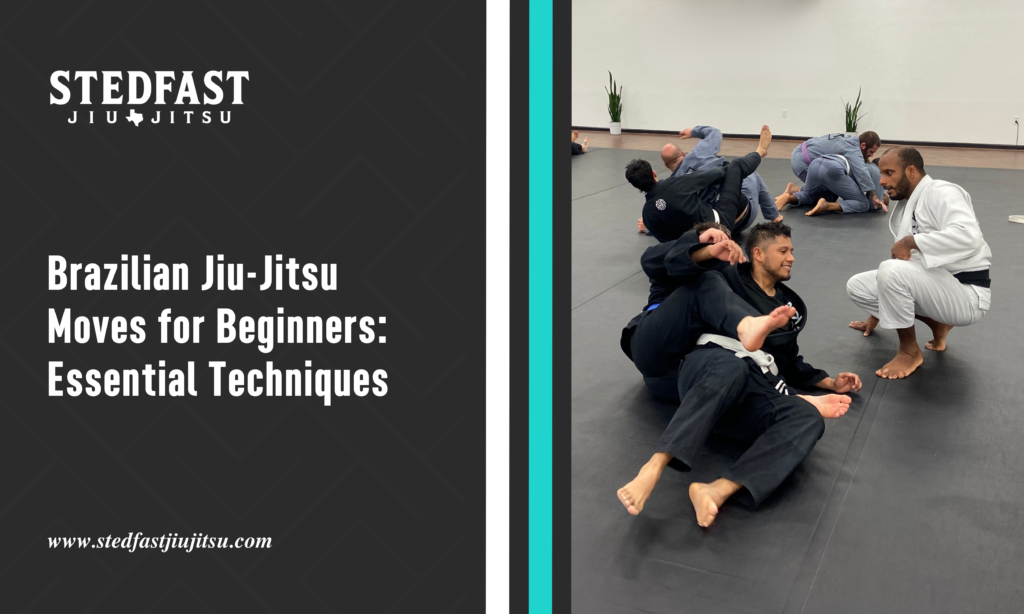
Walking into your first Brazilian Jiu-Jitsu class can feel exciting and confusing at the same time. You may see students moving quickly from one position to another, escaping pressure, controlling their partners, and using techniques that seem difficult to follow. For a beginner, it can feel like there is a lot to learn.
The good news is that no one is expected to understand everything on the first day. Jiu-Jitsu is built one movement at a time. Before students worry about advanced submissions or complicated combinations, they learn how to move safely, protect themselves, stay balanced, and remain calm when a position becomes uncomfortable.
At Stedfast School of Jiu-Jitsu, beginners are encouraged to focus on these fundamentals first. Whether someone joins adults Jiu-Jitsu or begins through kids Jiu-Jitsu, the goal is not to rush through techniques. It is to build a strong foundation that makes every future skill easier to understand.
These basic Brazilian Jiu-Jitsu moves may look simple, but they teach some of the most important lessons students will carry throughout their training.
Learning How to Move Before Learning How to Win
One of the biggest mistakes beginners can make is thinking Jiu-Jitsu is mainly about submissions. Submissions are part of the sport, but good Jiu-Jitsu begins much earlier.
A student first needs to understand how their body moves on the mat. They learn how to create space, keep their balance, protect vulnerable positions, and recognize when they are safe or in trouble.
These fundamentals help students stop relying only on strength. Instead of pushing harder every time something feels difficult, they begin to use timing, leverage, and body position.
That change is one of the first moments when Jiu-Jitsu begins to make sense.
The Hip Escape Helps Beginners Create Space
The hip escape, often called shrimping, is one of the first movements many beginners practice.
The movement teaches students how to move their hips away from pressure instead of trying to push another person away with their arms. This becomes useful in many situations, especially when escaping from underneath a training partner.
At first, the movement can feel awkward. Students may wonder why they are repeating something that looks so simple. Over time, they realize the hip escape appears everywhere in Jiu-Jitsu.
It teaches an important lesson: when someone is applying pressure, the answer is not always to fight harder. Sometimes creating a little space is enough to change the entire position.
Bridging Teaches Students How to Use Their Whole Body
The bridge is another basic movement that beginners practice early.
While lying on the mat, students use their feet, hips, and core to lift and shift their body. This can help disturb a partner’s balance and create an opportunity to escape.
Beginners often try to solve problems with their arms because that feels natural. Bridging teaches them to use the stronger parts of their body instead.
This helps students understand one of the central ideas of Jiu-Jitsu: good technique connects the entire body.
A smaller student does not need to rely only on upper-body strength. By learning how to use the hips, legs, and correct angles, they can become much more effective while using less energy.
Frames Help Beginners Stay Calm Under Pressure
Being underneath another person can feel uncomfortable when you are new to Jiu-Jitsu. The natural reaction is often to push, tense up, and try to escape as quickly as possible.
Frames help students respond differently.
A frame is a strong body structure that helps maintain space between two people. Instead of trying to hold someone’s weight away with muscle alone, students learn to position their arms and body so they can manage pressure more efficiently.
This can make a major difference for beginners.
They start to realize they do not need to panic simply because someone is above them. They can create structure, breathe, and begin solving the position one step at a time.
That calmness becomes one of the most valuable skills Jiu-Jitsu teaches.
The Technical Stand-Up Builds Balance and Control
Getting back to your feet sounds simple until another person is nearby and movement needs to stay controlled.
The technical stand-up teaches students how to rise from the ground while protecting themselves and maintaining balance.
Rather than turning away or standing carelessly, students learn how to keep space, stay aware, and return to their feet with control.
For beginners, this movement builds coordination and confidence. It also reinforces the idea that small details matter. Where the hands go, where the feet are placed, and how the body is balanced can completely change how safe and effective the movement becomes.
Guard Teaches Beginners That Bottom Position Is Not Helpless
One of the most interesting lessons for new students is learning about guard.
A beginner may assume that being on their back means they are losing. Jiu-Jitsu teaches something different.
From guard, students learn how to use their legs, hips, and grips to control distance and manage another person’s movement. They begin to understand that being underneath someone does not automatically mean they have no options.
This can be a powerful confidence-building lesson, especially for smaller students.
Instead of reacting with fear, they learn to recognize the position, protect themselves, and decide what to do next.
For children in kids Jiu-Jitsu classes, these lessons are introduced gradually so students can learn control, patience, and safe movement at a pace that makes sense for them.
Escaping Mount Builds Confidence Step by Step
Mount is one of the positions that can make beginners feel the most uncomfortable.
When another student is positioned above them, the beginner may initially feel stuck. This is exactly why learning basic mount escapes matters.
Students learn how to protect their arms, keep their body structured, use their hips, and create the movement needed to improve their position.
The bigger lesson is emotional as much as physical.
They learn that feeling stuck does not mean they are truly stuck.
They can breathe. They can think. They can remember what they practiced. Then they can work through the problem one step at a time.
As these small escapes begin to work, confidence grows naturally.
Side Control Teaches Patience Instead of Panic
Side control is another position beginners encounter often.
It can feel heavy, especially when someone has more experience and understands how to apply pressure. New students often want to move immediately, but unnecessary movement can make them tired quickly.
Jiu-Jitsu teaches students to slow down.
They learn how to create frames, protect their space, move their hips, and wait for the right opportunity to escape.
This is where beginners start to understand that Jiu-Jitsu is not about reacting to everything at once.
Sometimes the best decision is to stay calm, understand the position, and make one useful movement instead of five rushed ones.
Breakfalls Help Students Learn to Land Safely
Learning how to fall is just as important as learning how to control someone else.
Breakfalls teach students how to protect themselves when they go to the ground. This becomes especially useful as beginners start learning takedowns or working more from standing positions.
Many people naturally tense up when they think they may fall. Practicing safe falling techniques helps remove some of that fear.
Students become more comfortable with movement because they trust themselves to land properly.
For both children and adults, that confidence can make training feel much safer and more enjoyable.
Learning to Tap Is Part of Learning Jiu-Jitsu
Beginners sometimes worry that tapping means losing. In Jiu-Jitsu, tapping is simply part of safe training.
A tap tells your partner that a position or submission has reached the point where they should stop. Training partners learn to respond immediately and respectfully.
This creates trust on the mat.
Students know they can practice challenging positions because there is a clear way to communicate when they need to stop.
Learning to tap also teaches humility. There will always be techniques you do not understand yet and positions where someone else has more experience. That is not failure. It is part of learning.
The goal of training is not to win every round. It is to leave each round knowing a little more than you did before.
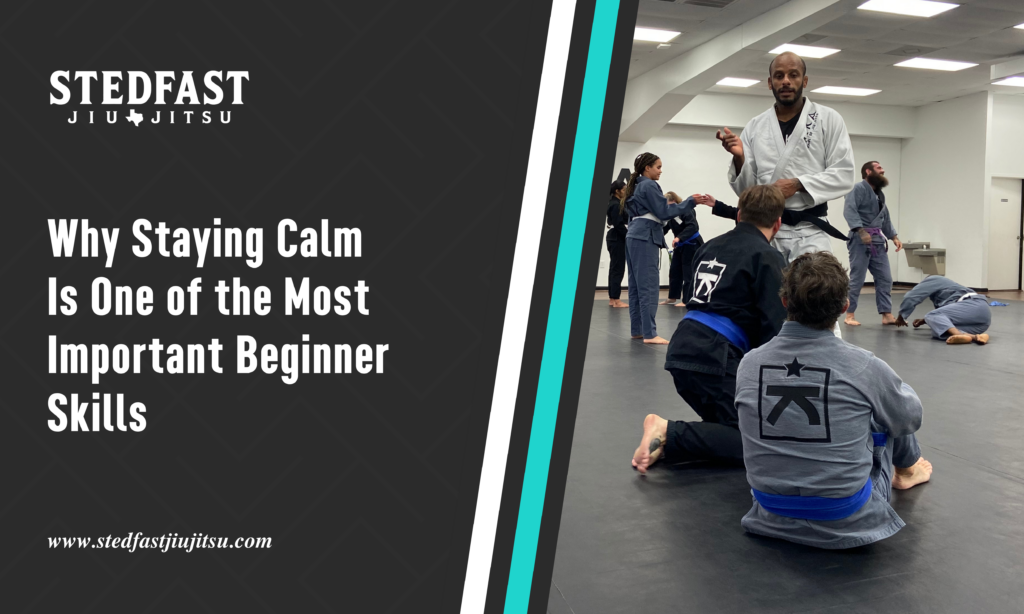
Why Staying Calm Is One of the Most Important Beginner Skills
Most beginners use too much energy at first.
They hold their breath. They grip too hard. They move quickly because they are afraid of getting stuck. After a few minutes, they are exhausted.
With time, they begin to slow down.
They learn to breathe under pressure. They recognize familiar positions. They stop trying to force every movement.
This is where Jiu-Jitsu begins to change from something that feels chaotic into something that feels understandable.
Students realize that they do not need an immediate answer to every problem. They just need to stay calm enough to find the next step.
That lesson reaches far beyond the academy. Learning to stay composed when things feel difficult can help students handle pressure at school, at work, in sports, and in everyday life.
How Stedfast Helps Beginners Build Strong Fundamentals
At Stedfast School of Jiu-Jitsu, beginners are given time to learn without feeling pressured to keep up with more experienced students. Classes focus on safety, clear instruction, respect, and steady improvement. Students are encouraged to ask questions, learn from mistakes, and build confidence one technique at a time.
Good Jiu-Jitsu Starts With the Basics
Beginners do not need to memorize dozens of techniques during their first few weeks.
Learning how to move your hips, bridge, create frames, understand guard, escape difficult positions, fall safely, and tap when necessary creates a much stronger foundation than rushing toward advanced techniques.
These movements teach more than physical skills. They teach patience, control, awareness, and the confidence to stay calm when something feels difficult.
At first, every position may feel unfamiliar. After consistent training, patterns begin to appear. Students recognize where they are, understand where they need to go, and start solving problems with less effort.
That progress does not happen all at once. It grows through small moments on the mat.
One escape becomes easier. One movement feels more natural. One difficult position no longer creates panic.
For adults and families in Sugar Land and Missouri City who are curious about Brazilian Jiu-Jitsu, there is no need to know these techniques before stepping into class. That is what training is for.
If you or your child are ready to begin learning in a safe and supportive environment, contact Stedfast School of Jiu-Jitsu and take the first step onto the mat.
Learn the basics. Build confidence. Keep showing up. The rest grows from there.