
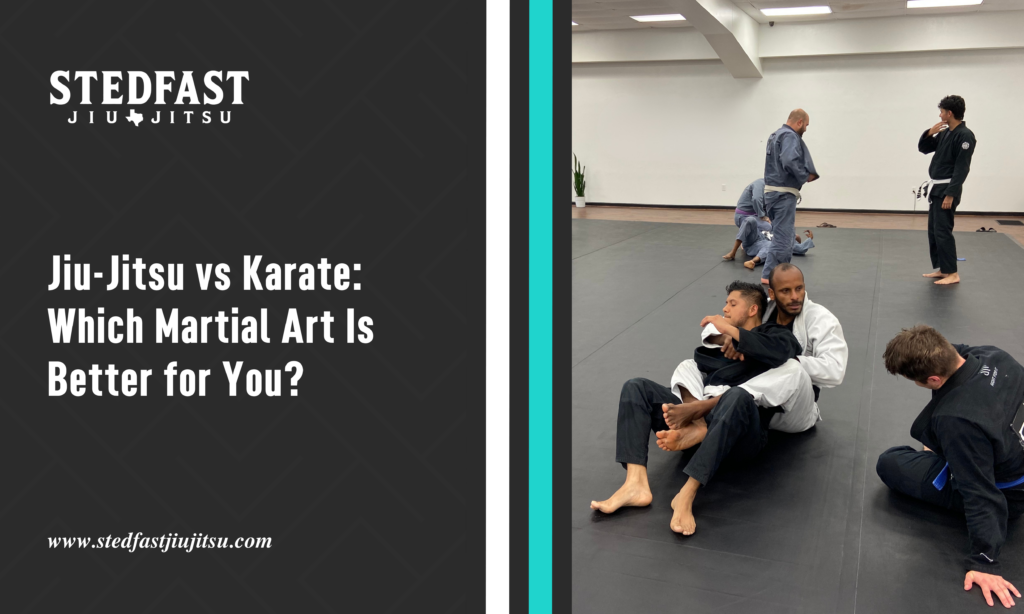
Choosing a martial art is not always as simple as picking the one that looks the most exciting. Parents may be looking for an activity that builds confidence and discipline in their child, while adults may want practical self-defense, better fitness, stress relief, or a new challenge.
Jiu-Jitsu and Karate are two of the most well-known martial arts, and both have a lot to offer. They can improve coordination, focus, confidence, and physical fitness, but the way students train is very different.
Understanding those differences can make it easier to decide which martial art fits your personality, goals, and preferred way of learning.
The Main Difference Between Jiu-Jitsu and Karate
The biggest difference is the type of movement each martial art focuses on.
Karate is primarily a striking martial art. Students commonly practice punches, kicks, blocks, footwork, and combinations. Many styles also include kata, which are structured sequences of movements that help students develop coordination, balance, timing, and technique.
Brazilian Jiu-Jitsu is centered around grappling. Students learn how to control another person, escape difficult positions, maintain balance, use leverage, and defend themselves when physical contact becomes close.
In adults Jiu-Jitsu classes, students spend a lot of time learning how to stay calm when someone is applying pressure or trying to improve their position.
Instead of relying mainly on punches or kicks, the focus is on positioning, timing, technique, and control.
Karate Builds Striking Skills and Distance Control
Karate can be an excellent choice for people who enjoy fast movements and structured technique.
Students learn how to move in and out of range, deliver strikes with control, and react quickly. Repetition plays an important role, helping movements become smoother and more precise over time.
For some students, this structure is very rewarding. They enjoy practicing combinations, improving their form, and seeing how small technical adjustments make their movements sharper.
Karate may especially appeal to someone who wants to focus on stand-up striking and prefers training that involves more distance between partners.
Jiu-Jitsu Turns Training Into Problem-Solving
Jiu-Jitsu feels very different because another person is constantly affecting what happens next.
A student may understand exactly what technique they want to use, but their training partner is moving, adjusting their weight, changing position, and trying to solve the same problem from the other side.
This means students are always thinking.
They learn how to create space, protect themselves, maintain balance, recognize opportunities, and choose the safest next move.
For children in kids Jiu-Jitsu classes, that problem-solving can help develop patience and focus. They begin to understand that rushing is not always the answer. Sometimes slowing down, thinking, and making a small adjustment works better.
That lesson can carry into school, sports, and everyday challenges.
Which Martial Art Builds More Confidence?
Both Karate and Jiu-Jitsu can help students become more confident.
In Karate, confidence can develop as students improve their kicks, punches, balance, and forms. Learning new skills and progressing through ranks gives students clear evidence that their work is paying off.
Jiu-Jitsu builds confidence through a different kind of experience.
Students regularly find themselves in positions that initially feel difficult. Someone may be controlling them from the top, blocking an escape, or making them work harder than expected.
Over time, they learn not to panic.
They breathe, remember what they have practiced, and start solving the situation step by step.
That creates a quiet kind of confidence. Students begin to understand that being uncomfortable does not mean they are helpless.
They can stay calm and keep working.
Jiu-Jitsu vs Karate for Kids
For parents, the best choice often depends on the child.
Some children enjoy the repetition and structure of Karate. They like practicing techniques individually, working on forms, and improving their coordination through repeated movement.
Other children prefer a more interactive environment.
Jiu-Jitsu gives kids constant opportunities to work with partners, solve problems, and learn how to manage physical contact safely.
At the younger level, Little Kids Jiu-Jitsu introduces those ideas in a way that matches a child’s age and attention span.
Students learn how to listen, follow instructions, respect their training partners, and control their movements.
The goal is not to make children aggressive. It is to help them become more confident, disciplined, and comfortable handling challenges.
Which One Is Better for Self-Defense?
Self-defense is one of the biggest reasons people begin martial arts.
Karate teaches striking skills that can help someone understand distance, movement, and how to respond while standing.
Jiu-Jitsu focuses more heavily on situations where someone grabs, holds, tackles, or controls another person.
This can be valuable because real-life physical conflicts do not always stay at a comfortable striking distance.
Jiu-Jitsu students spend time learning how to protect themselves from difficult positions, escape pressure, and control another person without depending entirely on strength.
No martial art can guarantee safety, and avoiding conflict should always come first. However, practicing techniques against a resisting partner can help students understand what pressure and movement actually feel like.
That experience can make it easier to remain calm instead of freezing.
Fitness Looks Different in Each Martial Art
Both Jiu-Jitsu and Karate can provide a strong physical workout.
Karate can improve cardiovascular fitness, speed, balance, coordination, and flexibility through repeated striking and movement drills.
Jiu-Jitsu challenges the body in another way.
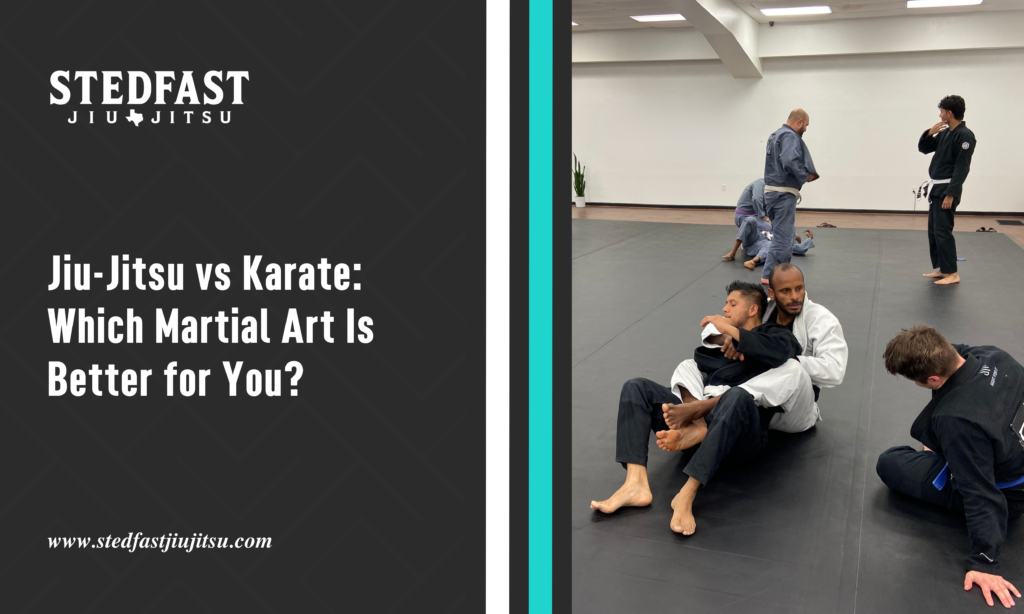
Students are constantly changing position, using their core, adjusting balance, moving their hips, controlling posture, and working against another person’s resistance.
The result is a workout that involves almost the entire body.
Many adults enjoy Jiu-Jitsu because they are so focused on learning that they stop thinking about the workout itself.
You are trying to understand a position or escape rather than counting repetitions.
By the end of class, you still know you worked hard.
Discipline and Respect Matter in Both
One thing Jiu-Jitsu and Karate have in common is the importance of discipline.
Progress takes time.
Students have to listen, practice, repeat techniques, accept mistakes, and keep showing up even when improvement feels slow.
Both martial arts also teach respect for instructors and training partners.
In Jiu-Jitsu, that respect is especially important because students work so closely with one another. They learn when to slow down, how to tap safely, when to stop, and how to help a partner learn without turning every round into a competition.
That creates responsibility.
Students begin to understand that good training is not only about what they can do. It is also about how they treat the person training with them.
The Right Academy Matters as Much as the Martial Art
A martial art can only be as positive as the environment where it is taught.
Some students thrive in highly competitive settings. Others need an academy where they can learn gradually without feeling pressured to prove themselves.
Parents should pay attention to how instructors communicate with children, how safety is handled, and how experienced students treat beginners.
Adults should look for the same things.
A good martial arts school should make students feel challenged without making them feel unsafe or unwelcome.
The right culture can make the difference between training for a few weeks and building a habit that lasts for years.
How Stedfast Approaches Jiu-Jitsu Training
At Stedfast School of Jiu-Jitsu, training is built around safety, respect, patience, and steady improvement.
Students are encouraged to learn at their own pace, work with their training partners rather than against them, and focus on becoming more confident and capable over time.
Which Martial Art Matches Your Personality?
Sometimes the easiest way to choose is to think about what you enjoy.
Karate may be a better fit if you like:
- Punches, kicks, and stand-up movement
- Structured repetition and forms
- Working on speed, timing, and distance
Jiu-Jitsu may appeal more if you enjoy:
- Problem-solving and strategy
- Working closely with a training partner
- Learning through live resistance
- Grappling, control, and escapes
Neither list makes one martial art better than the other.
They simply offer different ways to learn.
Finding the Right Martial Art for You
Jiu-Jitsu and Karate can both teach lessons that go far beyond physical technique.
They can build discipline, confidence, body awareness, patience, and respect.
The better choice depends on what you want from training.
If you enjoy striking, movement, forms, and learning how to manage distance, Karate may be a strong fit.
If you are interested in grappling, problem-solving, body control, and learning how to stay calm under pressure, Jiu-Jitsu may feel more natural.
For families and adults in Sugar Land and Missouri City, the best way to understand that difference is to experience training for yourself.
You do not need previous martial arts experience, and you do not need to be in perfect shape before starting.
If Jiu-Jitsu sounds like the right direction for you or your child, contact Stedfast School of Jiu-Jitsu and step onto the mat.
Sometimes the best martial art is simply the one that keeps you learning, growing, and wanting to come back.