by Adele | Oct 30, 2026 | Brazilian Jiu-Jitsu

Turning 40 can change the way you think about exercise. Maybe the workouts you enjoyed years ago no longer feel interesting, or you want something that challenges your mind as much as your body. You may also be looking for better fitness, practical self-defense skills, or simply an activity that gives you something new to work toward.
Then Brazilian Jiu-Jitsu catches your attention.
The only problem is the question that follows: am I too old to start?
For most adults, being over 40 does not mean Jiu-Jitsu is out of reach. It simply means training should be approached with patience, awareness, and realistic expectations. You do not need to move like a 20-year-old student or train at the same intensity to make meaningful progress.
At Stedfast School of Jiu-Jitsu, adults can begin with no previous martial arts experience and build their skills one class at a time. The goal is not to prove how tough you are on the first day. It is to learn how to train in a way that keeps you improving and enjoying the process.
You Do Not Need to Be in Perfect Shape Before Starting
One of the most common reasons adults delay trying Jiu-Jitsu is because they think they need to get fit first. They imagine everyone in class will already be strong, flexible, and able to train without getting tired.
That is not how beginners start.
Jiu-Jitsu uses movement patterns that may be unfamiliar even to someone who already exercises regularly. A runner, weightlifter, or cyclist can still feel tired during the first few classes because grappling asks the body to move, balance, and respond in completely different ways.
Fitness improves through training.
Instead of waiting until you feel ready enough, it often makes more sense to begin at a comfortable pace and allow your conditioning to build alongside your technique.
Starting After 40 Means Training Smarter
A younger student may be able to train hard several days in a row and feel ready to do it again the next morning. After 40, many adults become more aware of how important recovery is between physically demanding activities.
That does not make Jiu-Jitsu less suitable. It simply changes the approach.
You do not need every round to be intense. Some of the most productive classes are the ones where you slow down, pay attention to technique, and leave enough energy to return feeling good for the next session.
Consistency matters more than proving how hard you can train in one night.
An adult who trains at a manageable pace for years will gain far more than someone who tries to do too much during the first month and quickly becomes discouraged.
Technique Matters More Than Trying to Keep Up
Walking into adults Jiu-Jitsu after 40 may mean sharing the mat with younger students who move faster or recover more quickly. It can be tempting to measure your progress against theirs.
That comparison usually does not help.
Brazilian Jiu-Jitsu rewards timing, positioning, leverage, patience, and awareness. Learning how to move efficiently is more valuable than trying to match another student’s speed or strength.
In fact, slowing down can help beginners understand Jiu-Jitsu more clearly. Instead of reacting quickly to everything, you begin to recognize what position you are in, where the pressure is coming from, and what movement actually needs to happen next.
That is when training starts feeling less chaotic and more like problem-solving.
Recovery Becomes Part of Your Training
Progress does not only happen while you are on the mat. Your body also needs time between classes to adjust to unfamiliar movement and physical pressure.
Getting enough sleep, staying hydrated, eating well, and giving yourself appropriate rest can make it easier to return to class ready to learn. You may also notice general soreness during your first weeks as your body becomes familiar with grappling.
The important part is learning the difference between normal effort and something that does not feel right.
If you have an existing injury, recent surgery, movement limitation, or another health concern, get appropriate professional guidance before beginning and let your instructor know. Good communication makes it easier to adjust training when needed.
Learning to Tap Early Protects Long-Term Progress
One of the most important skills for any beginner is knowing when to tap.
Tapping tells your training partner to stop a submission or position immediately. It is not a sign that you failed the round, and there is no reason to wait until something becomes painful just to prove that you can tolerate it.
For adults over 40, this mindset can be especially valuable.
You are training to learn, improve, and return for another class. Holding onto a position because of pride does not help that goal.
Experienced students understand that tapping is simply part of Jiu-Jitsu. You reset, learn what happened, and continue training.
That habit protects more than your body. It teaches humility and helps remove the pressure to treat every practice round like a competition.

Choose Training Partners Who Help You Learn
The person you train with can make a big difference in how comfortable your first months feel.
Good training partners understand how to control their weight and intensity. They give beginners opportunities to work through positions instead of turning every round into a test of strength or speed.
This is one reason academy culture matters so much.
A supportive student can challenge you without making you feel unsafe. They know when to increase the pace and when to slow down, and they understand that both people should leave the round having learned something.
As you gain experience, you begin developing that same responsibility toward other students.
Jiu-Jitsu becomes less about beating the person in front of you and more about helping each other improve.
You May Be More Flexible Than You Think
Some adults hesitate to start because they cannot touch their toes or move the way experienced Jiu-Jitsu students do.
You do not need exceptional flexibility to begin.
Jiu-Jitsu techniques can be adjusted for different body types, movement abilities, and levels of experience. As students train consistently, they often become more comfortable moving their hips, changing levels, maintaining balance, and getting up from the ground.
The goal is not to force your body into positions it is not ready for.
Progress happens gradually. What feels awkward during the first class may feel completely normal several months later.
Jiu-Jitsu Can Make Exercise Interesting Again
By the time many adults reach their forties, they have tried plenty of workouts.
Gym memberships come and go. Running can become repetitive. Home workout routines may work for a few weeks before motivation disappears.
Jiu-Jitsu feels different because every class gives you something to learn.
You are not simply completing repetitions. You are trying to understand how a position works, why an escape failed, or how one small adjustment can change the entire situation.
While your body is working, your mind is involved too.
That combination can make it easier to stay engaged because progress is not measured only by calories, weight, or how much you can lift. It can also be measured by understanding something today that confused you last month.
Confidence Builds Differently After 40
Starting something completely new as an adult can be uncomfortable.
You may be successful in your career, confident as a parent, or experienced in other areas of life, and suddenly find yourself on the mat not knowing where your hands or feet should go.
That experience can be humbling, but it can also be refreshing.
You learn that being a beginner is not something to avoid. It is an opportunity to grow.
As techniques begin making sense, confidence develops naturally. You recognize positions faster. You stay calmer under pressure. You stop worrying as much about making mistakes.
Those small wins can become one of the most rewarding parts of training.
Private Lessons Can Make the First Steps Easier
Some adults prefer additional guidance when beginning Jiu-Jitsu, especially if they have movement concerns or simply want more time to understand the basics.
Jiu-Jitsu private lessons can provide a quieter environment to work through positions, ask questions, and build confidence before or alongside group training.
Private training is not necessary for every beginner.
For some students, however, the extra attention can make unfamiliar movements feel easier to understand and help them become more comfortable before joining faster-paced situations.
How Stedfast Supports Adults Starting Later
At Stedfast School of Jiu-Jitsu, adults are encouraged to train with patience, control, and respect for their individual starting point. Beginners can focus on strong fundamentals, safe movement, and steady improvement without feeling pressure to keep up with someone else’s pace.
Your Progress Does Not Need to Look Like Anyone Else’s
One of the best things about beginning Jiu-Jitsu after 40 is realizing that your goals can be completely different from the person training beside you.
One student may want to compete.
Another may want to improve fitness.
Someone else may want better self-defense skills, less stress, or an activity they can enjoy for years.
None of those reasons is more valid than another.
Your Jiu-Jitsu journey can fit around your work, family responsibilities, and recovery. You do not need to train every day to belong on the mat.
What matters is finding a pace you can maintain.
Starting at 40 Is Still Starting
There is no perfect age to begin Brazilian Jiu-Jitsu.
Starting when you are younger gives you more years on the mat, but starting after 40 often comes with qualities that can help you train well. Patience, life experience, discipline, and a better understanding of your own limits can all become strengths.
The first few classes may still feel challenging. You will probably encounter movements you have never done before, and there will be positions where you have no idea what to do.
That is part of being new.
With time, those unfamiliar situations become recognizable. Your movement becomes more comfortable, your conditioning improves, and you start finding solutions where you once only saw problems.
For adults in Sugar Land and Missouri City who have been wondering whether they waited too long to try Jiu-Jitsu, the better question may be whether you are ready to start now.
You do not need to prove anything before walking through the door.
If you are ready to experience Jiu-Jitsu in a safe and supportive environment, contact Stedfast School of Jiu-Jitsu and take your first step onto the mat.
Forty is not the end of learning something new. It can be the beginning of something you continue for years.

by Adele | Oct 20, 2026 | Brazilian Jiu-Jitsu

Choosing a martial art often starts with a simple question: what kind of training feels right for me? For families and adults exploring grappling, Judo and Brazilian Jiu-Jitsu are two names that often come up together.
They have a lot in common. Both teach students how to use balance, leverage, timing, and body positioning instead of relying only on strength. Both also require students to work closely with training partners and learn how to stay controlled under physical pressure.
The biggest difference is where each martial art spends most of its time. Judo puts much more emphasis on standing throws and takedowns, while Brazilian Jiu-Jitsu continues developing the fight once it reaches the ground.
Neither approach is automatically better. They simply teach students to solve different parts of the same grappling problem.
Judo vs. Brazilian Jiu-Jitsu
The easiest way to understand the difference is to compare how each martial art approaches movement, control, and training.
| Feature |
Judo |
Brazilian Jiu-Jitsu |
| Main focus |
Throws and takedowns |
Ground control and submissions |
| Starting position |
Mostly standing |
Standing and ground |
| Groundwork |
More limited |
Major part of training |
| Key skills |
Balance, timing, throwing |
Positioning, escapes, control |
| Good fit for |
People who enjoy throws and fast standing exchanges |
People who enjoy detailed ground problem-solving |
Judo Focuses More on Throws and Standing Control
Judo is known for powerful throws, trips, foot sweeps, and techniques that use an opponent’s balance against them. Students spend a lot of time learning how to move while standing, control grips, create an opening, and safely bring another person to the mat.
Because throwing is such an important part of Judo, students also spend time learning how to fall correctly. Being comfortable going to the ground helps them train with more confidence and reduces some of the fear that can come with being thrown.
Timing is extremely important.
A successful throw is rarely about simply lifting someone with strength. Students learn to feel when their partner is off balance and use that moment to complete the movement with better technique.
Brazilian Jiu-Jitsu Spends More Time on the Ground
Brazilian Jiu-Jitsu includes takedowns, but much of the learning happens after both people reach the mat. Students practice positions such as guard, mount, side control, and back control while learning how to escape, improve position, and maintain control.
For beginners, this creates a different type of challenge. Instead of trying to throw someone quickly, students may spend time solving a position step by step. They learn where to place their arms, how to move their hips, when to create space, and when staying patient is better than moving immediately.
In adults Jiu-Jitsu, these situations give students repeated opportunities to practice staying calm under pressure.
What feels confusing at first gradually becomes a problem they know how to work through.
Both Martial Arts Use Leverage Instead of Only Strength
One reason Judo and Brazilian Jiu-Jitsu appeal to so many different people is that both are built around efficient movement. A smaller student cannot always overpower someone larger, so they need to understand balance, positioning, angles, and timing.
Judo may use those ideas to disrupt someone’s balance before a throw. Jiu-Jitsu may use them to escape from underneath a heavier training partner or maintain control without exhausting unnecessary energy.
This teaches students an important lesson early.
Strength can help, but knowing how and when to move usually matters more than simply trying harder.
The Pace of Training Can Feel Different
Judo often has quick moments of movement where both students are standing and searching for the right opportunity to complete a throw. Balance can change quickly, which means students need to react to shifts in weight, foot placement, and grips.
Brazilian Jiu-Jitsu can also move quickly, but many ground positions allow students to spend more time working through a problem. A beginner may be able to slow down, recognize where they are, and make several smaller adjustments before the position changes.
That does not mean Jiu-Jitsu is always slower.
A live round can move rapidly between positions, especially as students gain experience. The difference is that the ground gives students another layer of control and problem-solving that becomes central to BJJ training.
The Uniform and Grips Have Similarities
Traditional Judo and Gi Jiu-Jitsu both use a durable uniform that gives students additional ways to control a partner. Sleeves and collars can become important tools for managing posture, creating movement, and maintaining grips.
Brazilian Jiu-Jitsu also has No-Gi training, where students wear athletic clothing instead of the traditional uniform. Without sleeves or collars to hold, students need to rely more directly on body positioning, wrist control, pressure, and connection.
This gives BJJ students different ways to experience grappling.
The fundamental goal remains the same: learn how to control movement without relying on uncontrolled force.

Ground Fighting Creates a Different Kind of Problem-Solving
One of the biggest adjustments for new Brazilian Jiu-Jitsu students is learning that being underneath someone does not always mean they have lost.
From positions such as guard, students still have ways to manage distance, protect themselves, create movement, and improve their situation.
This can be surprising for beginners.
They learn that a difficult position is not automatically a hopeless one. Instead of panicking, they begin looking for frames, space, balance, and the next useful movement.
That problem-solving mindset becomes one of the most important parts of Jiu-Jitsu. Students learn to stay patient when the answer is not immediately obvious, which is a skill that can carry into challenges well beyond the mat.
Judo and Jiu-Jitsu Approach Competition Differently
Competition rules also help explain why the two martial arts developed different training priorities.
Judo competition places major importance on successful throws and standing control. Groundwork is still part of the sport, but students are encouraged to make progress rather than remaining in one ground position for long periods.
Brazilian Jiu-Jitsu competition gives much more room for extended ground exchanges. Students can work through guard, passes, sweeps, dominant positions, and submissions as the match develops.
A beginner does not need to compete to benefit from either martial art.
Competition is simply one way to understand why Judo became especially strong in standing throws while Brazilian Jiu-Jitsu developed such a deep system of ground control.
Which Is Better for Self-Defense?
Both martial arts teach useful skills for managing physical contact.
Judo helps students become comfortable staying balanced while someone is gripping them and teaches ways to bring another person to the ground. Brazilian Jiu-Jitsu focuses heavily on what happens when close contact continues or someone ends up underneath another person.
Real situations are unpredictable, so no martial art can prepare someone for every possible circumstance.
The most valuable skills often begin before any individual technique. Students learn how to stay calm when someone is applying pressure, how to move with control, and how to avoid reacting only through panic or strength.
That confidence grows through practice.
Which Martial Art Is Better for Kids?
Both Judo and Brazilian Jiu-Jitsu can teach children discipline, coordination, respect, patience, and how to work safely with another person.
The better choice may come down to what the child enjoys and the environment where they train.
Some children may enjoy the faster standing exchanges and throws found in Judo. Others may connect more with the problem-solving side of Brazilian Jiu-Jitsu and the opportunity to work through positions on the ground.
In kids Jiu-Jitsu classes, children also learn how to listen, control their strength, respect boundaries, and work cooperatively with their training partners.
Those lessons matter just as much as the techniques themselves.
Which One Is Better for Beginners?
There is no single answer because beginners come to martial arts with different goals.
Someone fascinated by throws, standing balance, and fast takedowns may naturally enjoy Judo. Someone who enjoys detailed problem-solving, ground control, escapes, and learning how to work from difficult positions may prefer Brazilian Jiu-Jitsu.
The quality of the training environment also matters.
Beginners need instructors and partners who understand that learning takes time. A good academy should make new students feel challenged without making them feel pressured to prove themselves immediately.
You should be able to ask questions, make mistakes, and improve at a pace that allows you to keep coming back.
Can Learning One Help With the Other?
Because Judo and Brazilian Jiu-Jitsu share many grappling principles, experience in one can help students understand parts of the other.
A Judo student may bring strong balance, grip awareness, and throwing ability into Jiu-Jitsu. A BJJ student may already understand ground control, escapes, and how to stay comfortable when a match continues after the takedown.
Training does not have to become a choice between respecting one martial art and respecting the other.
Both have valuable lessons.
Understanding their differences can actually make it easier to appreciate what each does especially well.
How Stedfast Approaches Brazilian Jiu-Jitsu
At Stedfast School of Jiu-Jitsu, students are encouraged to build their skills through safe, controlled, and supportive training. Beginners can focus on strong fundamentals, steady improvement, and learning how to work with training partners respectfully rather than feeling pressure to keep up with someone else’s pace.
Finding the Martial Art That Fits You
Judo and Brazilian Jiu-Jitsu come from closely related grappling traditions, but they have developed different strengths.
Judo places greater attention on standing balance, throws, trips, and takedowns. Brazilian Jiu-Jitsu spends more time developing ground control, escapes, guard work, positioning, and submissions.
Both can improve fitness, coordination, confidence, discipline, and body awareness.
The right choice comes down to the type of movement you enjoy and the skills you want to spend time developing. You may be drawn to the feeling of completing a well-timed throw, or you may enjoy the slower problem-solving that happens when working through a difficult ground position.
For adults and families in Sugar Land and Missouri City who are curious about Brazilian Jiu-Jitsu, you do not need any previous grappling experience before starting.
You simply need to be willing to learn.
If you or your child are interested in experiencing Brazilian Jiu-Jitsu in a safe and supportive environment, contact Stedfast School of Jiu-Jitsu and take the first step onto the mat.
The best martial art is not always the one that looks most impressive from the outside. It is the one that gives you a reason to keep learning, growing, and coming back.

by Adele | Oct 10, 2026 | Brazilian Jiu-Jitsu

Walking into a Brazilian Jiu-Jitsu academy for the first time can bring a lot of new questions. One of the first may be surprisingly simple: why are some students wearing the traditional uniform while others are training in shorts and a fitted shirt?
These are the two common ways to train Brazilian Jiu-Jitsu: Gi and No-Gi.
Both styles teach the same core ideas of position, control, escapes, submissions, balance, and problem-solving. The difference is that clothing changes how students control each other, which can make the pace and feel of training noticeably different.
For a beginner, there is no need to decide that one style is better before ever stepping on the mat. Understanding what makes Gi and No-Gi different can simply help you feel more prepared and comfortable when you begin training.
What Is Gi Jiu-Jitsu?
Gi Jiu-Jitsu is practiced while wearing the traditional Jiu-Jitsu uniform. The Gi includes a jacket, pants, and belt, but the uniform is not only clothing. It also becomes part of the technique because students can use the sleeves, collar, and other areas of the fabric to help control their training partner.
These extra grip options give students more ways to slow movement, maintain position, and create opportunities for techniques. For beginners, this can make training feel more methodical because there are often more ways to hold a position before it changes.
There are still plenty of fast moments in Gi training, but the additional grips can give new students a little more time to understand what is happening.
That can be helpful when the positions, terminology, and movements are still unfamiliar.
What Is No-Gi Jiu-Jitsu?
No-Gi Jiu-Jitsu removes the traditional uniform. Students usually train in a fitted rash guard with grappling shorts or similar athletic clothing, and because there are no sleeves or collars to grab, control has to come directly from the body.
Students learn to use grips around the wrists, arms, head, legs, and upper body while relying more heavily on positioning, pressure, and body connection. The lack of fabric also makes it harder to hold someone in place.
Because of this, No-Gi often feels faster.
For some beginners, that quicker movement feels exciting. For others, it may take a little longer before the pace starts to feel manageable, especially when positions begin changing quickly during live training.
The Biggest Difference Is How You Grip
One of the easiest ways to understand Gi vs No-Gi is to look at how students use their hands. In Gi training, the uniform gives students additional places to grip, such as the sleeves and collar, which can help manage posture and control movement.
In No-Gi, those grips disappear. Students have to control the person rather than the clothing, which means relying more on body position, hooks, pressure, wrist control, and other forms of connection.
Neither approach is better.
They simply teach students to solve similar problems with different tools, and both can improve control, positioning, and awareness.
Gi Training Can Teach Patience and Control
Beginners often want to move immediately when they feel pressure. If someone starts passing their guard or gains a strong position, the natural reaction may be to pull away, push harder, or try to escape before understanding what is actually happening.
Gi training can encourage students to slow down. Because a training partner may have a strong sleeve or collar grip, simply pulling away is not always enough. Students have to understand what is controlling them before they can solve the problem.
Over time, beginners become better at recognizing grips, improving their position, and making small adjustments instead of trying to force an escape.
This teaches one of the most valuable lessons in Jiu-Jitsu: staying calm often gives you more options than rushing.
No-Gi Training Encourages Quick Reactions and Movement
No-Gi teaches many of the same ideas in a faster environment. Without fabric grips slowing movement, positions can change quickly, and students may move from one situation to another before they have much time to settle.
This encourages awareness and quicker decision-making. Beginners learn to pay attention to balance, body position, and movement because a small opening may disappear quickly if they hesitate too long.
At the same time, No-Gi also teaches that speed alone is not enough.
If a student moves quickly without control, they may simply create another problem. Good No-Gi training still depends on timing, patience, technique, and knowing where the body should be.
Do the Same Techniques Work in Both?
Many of the most important Jiu-Jitsu fundamentals appear in both Gi and No-Gi. Students still learn how to maintain position, escape mount, control side position, work from guard, protect themselves, and move safely with a training partner.
Basic movements such as bridging and hip escapes remain useful in both styles. Good posture, balance, pressure, timing, and awareness also continue to matter regardless of what someone is wearing.
The differences become more noticeable when a technique depends heavily on gripping the uniform. Gi training includes techniques that use collars and sleeves, while No-Gi students have to find another way to create the same type of control.
For beginners, this is a useful lesson. Jiu-Jitsu is not only a collection of moves. It is a set of principles that can be adapted depending on the situation.

Which Style Is Easier for Beginners?
There is no universal answer because every beginner learns differently. Some students feel more comfortable in the Gi because the additional grips can slow the pace and give them more time to recognize positions and think about what comes next.
Others prefer No-Gi because the clothing feels lighter and the movement feels more natural. The faster pace can also be appealing to students who enjoy movement, transitions, and quicker exchanges.
A beginner who starts in adults Jiu-Jitsu does not need to worry about choosing the perfect style immediately.
The most important early skills are learning how to breathe, move safely, protect yourself, work with a partner, and stay calm when a position feels unfamiliar.
What About Gi and No-Gi for Kids?
Children can benefit from the lessons found in either style. The most important part is making sure the training matches their age, experience, and ability to work safely with a partner.
In kids Jiu-Jitsu classes, students are learning much more than techniques. They are learning how to listen, respect boundaries, control their strength, communicate with training partners, and stay focused when something becomes difficult.
Whether they are training in Gi or No-Gi, those habits are what create long-term progress.
A child does not need to understand every technical difference before starting. They simply need an environment where they can learn safely, build confidence, and enjoy the process.
Does One Style Help More With Self-Defense?
Both Gi and No-Gi can help students become more comfortable with physical pressure and close contact. Gi training can teach students how to deal with clothing grips, while No-Gi develops control without depending on fabric.
Real situations can be unpredictable, which is why it is difficult to say one style prepares someone for every possible scenario. The more important lesson is learning how to stay calm, protect yourself, and make good decisions when someone is trying to control your movement.
Students become familiar with being grabbed, pressured, or placed in an uncomfortable position without immediately panicking.
That confidence comes from consistent training and experience, not from the clothing alone.
Training Both Can Build a More Complete Understanding
Students do not always need to choose one style forever. Training Gi can help develop grip awareness, patience, and detailed control, while No-Gi can challenge students to rely more on movement, body connection, and quick reactions.
Experiencing both can also make technical differences easier to understand. A technique that works easily with a sleeve grip may require a different approach without the Gi, while a position that feels stable in Gi may be harder to hold when there is less fabric to control.
These differences encourage students to adapt.
And learning how to adapt is a major part of Jiu-Jitsu.
How Stedfast Helps Beginners Learn Jiu-Jitsu
At Stedfast School of Jiu-Jitsu, beginners are encouraged to focus on safety, technique, patience, and steady improvement. Students can learn at their own pace in a respectful environment where experienced training partners help newer students become more comfortable on the mat.
The Best Style Is the One That Keeps You Learning
Gi and No-Gi may look different from the outside, but they are both part of the same Jiu-Jitsu journey. Gi offers more gripping options and often creates a more controlled, methodical style of training, while No-Gi removes those grips and usually creates faster movement with more emphasis on controlling the body directly.
Both styles can build fitness, confidence, problem-solving skills, patience, and body awareness. For beginners, the most important thing is not deciding which style is superior but becoming comfortable on the mat and learning the fundamentals.
The first few classes are about understanding basic positions, learning how to move safely, and realizing that you do not need to know everything right away. With time, you may discover that you prefer one style, or you may find that you enjoy both.
For adults and families in Sugar Land and Missouri City who are thinking about starting Brazilian Jiu-Jitsu, there is no need to figure everything out before your first class. Showing up ready to learn, asking questions, and giving yourself time to improve matters far more than choosing Gi or No-Gi on day one.
If you or your child are ready to experience Jiu-Jitsu in a safe and supportive environment, contact Stedfast School of Jiu-Jitsu and take the first step onto the mat.
Gi or No-Gi, the most important thing is finding a style of training that keeps you learning, improving, and coming back.

by Adele | Sep 30, 2026 | Brazilian Jiu-Jitsu
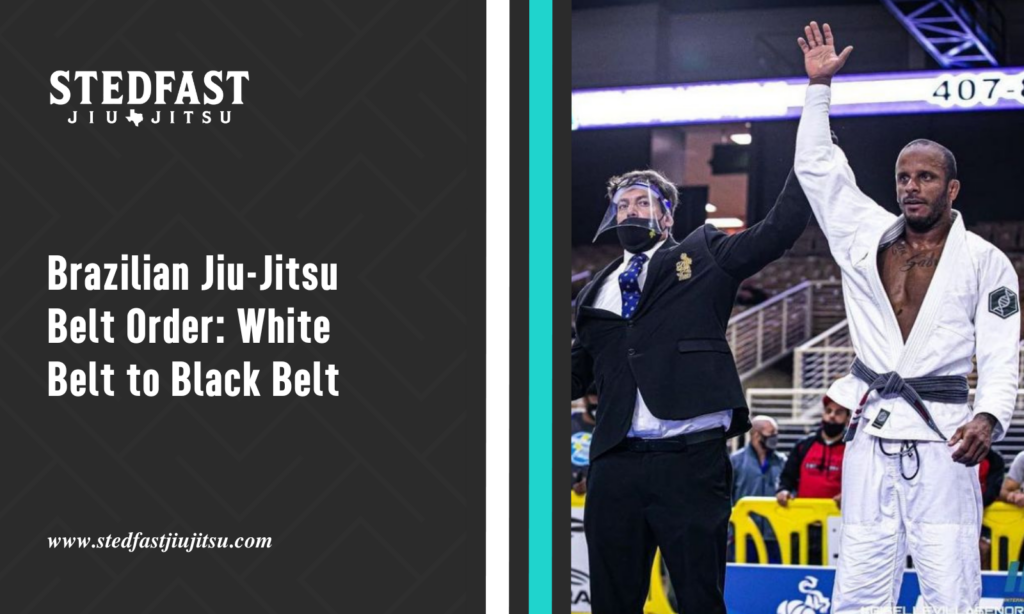
When someone begins Brazilian Jiu-Jitsu, the black belt can feel very far away.
A new student may look around the academy and see different colored belts tied around students who seem more confident, more comfortable, and more familiar with every position. It is natural to wonder how those students got there and what each belt actually means.
The Brazilian Jiu-Jitsu belt order gives students a way to recognize progress, but belts are about much more than memorizing techniques. Each rank represents time spent learning, making mistakes, becoming more patient, and understanding how to stay calm when things do not go as planned.
For adults, the familiar progression is white, blue, purple, brown, and black belt. These are also the standard belt categories used in IBJJF adult competition.
At Stedfast School of Jiu-Jitsu, the focus is not on rushing toward the next color. Students are encouraged to build skills that last, enjoy the learning process, and allow each belt to represent genuine growth.
White Belt: Learning How to Be a Beginner
Every black belt once walked onto the mat wearing a white belt.
The white belt stage is where students learn how Jiu-Jitsu works. Everything is new. Positions have unfamiliar names, movements may feel awkward, and even simple techniques can require more coordination than expected.
This stage is not about knowing everything.
It is about becoming comfortable with not knowing.
White belts begin learning how to move safely, protect themselves, recognize common positions, escape pressure, and work respectfully with training partners. They also learn one of the most important skills in Jiu-Jitsu: staying calm.
In the beginning, many students use too much strength. They grip too hard, hold their breath, and move quickly because they are worried about getting stuck.
Over time, those reactions begin to change.
Students start breathing more naturally. They recognize familiar situations. They understand that getting caught in a difficult position is not a reason to panic.
For students in adults Jiu-Jitsu, the white belt is where confidence begins to grow through small improvements.
One escape works.
One technique finally makes sense.
One round feels less overwhelming than it did a month earlier.
Those moments are what create the foundation for everything that follows.
Blue Belt: Building a Jiu-Jitsu Game
Reaching blue belt is a meaningful step because the student is no longer completely new to the language of Jiu-Jitsu.
They usually understand the major positions and have developed techniques they trust. Instead of simply reacting to everything that happens, they begin making plans.
A blue belt might recognize where they want a round to go.
They know which guard positions feel comfortable, which escapes work well for them, and which techniques connect naturally.
That does not mean training suddenly becomes easy.
In many ways, blue belt is where students begin to understand how much more there is to learn.
They are no longer overwhelmed by every detail, which allows them to notice smaller details. Timing becomes more important. Positioning becomes more precise. Students start learning why a technique works rather than simply remembering the steps.
This stage also teaches consistency.
Progress may not always feel as fast as it did during the first months of training. Students learn to keep showing up even when improvement is less obvious.
That patience is part of becoming a better Jiu-Jitsu student.
Purple Belt: Connecting the Pieces
By purple belt, Jiu-Jitsu begins to feel much more personal.
Students are no longer simply collecting techniques. They are connecting them.
A movement leads naturally into another movement. An escape becomes an attack. A failed technique creates another opportunity.
Purple belts often start developing a style that reflects their body type, personality, movement, and strengths.
A smaller student may become particularly good at creating angles and using speed. Another person may prefer pressure and control. Someone else may build their game around guard.
There is no single correct way to make Jiu-Jitsu work.
That is part of what makes this stage interesting.
Purple belt students also tend to become more aware of efficiency. They understand that using more strength does not always produce better results. Small adjustments in timing, weight, grips, and positioning can accomplish much more.
There is also a change in how experienced students interact with newer ones.
They may begin helping beginners understand movements, answering simple questions, and becoming the kind of training partner they once needed themselves.
Progress starts becoming about more than personal success.
Brown Belt: Refining Rather Than Collecting
Brown belt represents a high level of experience.
At this point, students already understand a large amount of Jiu-Jitsu. The focus often shifts away from learning as many new techniques as possible and toward making familiar techniques more precise.
Small details matter.
A slight change in pressure can improve control.
Better timing can turn a difficult technique into an efficient one.
A more patient reaction can create an opportunity that rushing would have missed.
Brown belts continue learning, but they also spend time polishing weaknesses and making their strongest areas more complete.
The mental side of training becomes just as important.
Experienced students understand that not every round needs to become a test of who can win. Good training requires control, awareness, and the ability to adjust intensity for different partners.
That maturity is one of the qualities that separates advanced students from beginners.
Black Belt: Mastery Does Not Mean the Learning Stops
A Brazilian Jiu-Jitsu black belt represents years of consistent learning, practice, discipline, and problem-solving.
But it does not represent the end.
Black belts continue learning just like everyone else.
They refine techniques, discover new details, adjust their game as their body changes, and learn from other students and instructors.
The difference is the depth of their understanding.
A movement that once required several steps may now feel natural. They can recognize patterns quickly and adapt when a position changes.
Just as importantly, experienced black belts often understand how much they still do not know.
That humility is an important part of Jiu-Jitsu.
The belt may change, but the process remains the same: show up, learn, make adjustments, and continue growing.
Stripes Mark Progress Between Belts
Students may also receive stripes on their belts as they develop.
Stripes can recognize progress between major belt promotions and give students smaller milestones along the way.
For a beginner, earning the first stripe can feel just as meaningful as a future belt promotion.
It represents all the classes where techniques felt confusing, all the rounds where something did not work, and all the times the student came back and tried again.
Different academies may approach stripes and promotions differently.
The important part is understanding that improvement is happening long before the color of the belt changes.
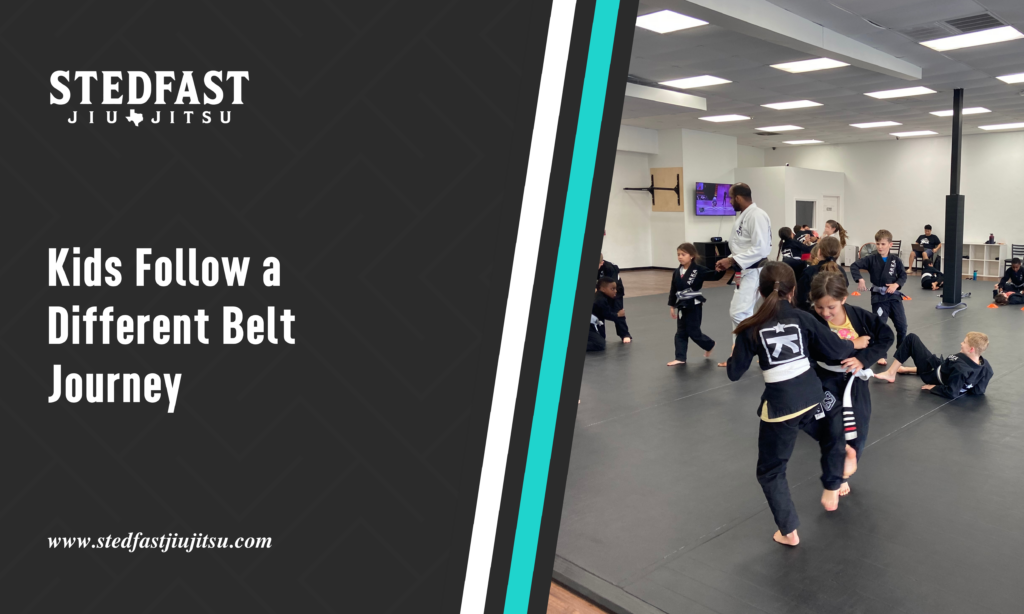
Kids Follow a Different Belt Journey
The belt system for children is different from the adult progression.
Youth Jiu-Jitsu includes additional colors such as gray, yellow, orange, and green, with available ranks changing as children grow older. Current IBJJF kids divisions use these youth belt categories based on age.
This gives children more milestones during years when they are developing quickly.
In kids Jiu-Jitsu classes, however, the value of promotion goes beyond learning techniques.
Children are also developing focus, patience, respect, self-control, confidence, and responsibility.
A new belt becomes something they worked toward through consistency.
They learn that progress does not happen simply because they want the next rank. It comes from listening, practicing, helping training partners, and continuing even when something feels difficult.
That makes promotion meaningful.
How Long Does It Take to Reach Black Belt?
One of the first questions new students often ask is how long the entire journey takes.
There is no single answer.
Brazilian Jiu-Jitsu is not a system where every student automatically receives a new belt after the same number of months.
Age, consistency, technical development, training experience, academy standards, competition experience, and the instructor’s evaluation can all affect progression. Governing organizations may also set minimum promotion periods for certain ranks, and those standards can change over time.
Some students train several times each week. Others balance Jiu-Jitsu with careers, school, children, or other responsibilities.
Their paths will look different.
That is perfectly normal.
The person training beside you is not the best measurement of your progress.
The better comparison is the student you were when you started.
Why Chasing the Next Belt Can Distract From Progress
Belts can be motivating.
They recognize effort and give students something meaningful to work toward.
But constantly thinking about the next promotion can make it harder to appreciate what is happening right now.
A white belt who only thinks about becoming a blue belt may overlook how much progress they have already made.
A blue belt who constantly compares themselves with purple belts may miss the techniques that are becoming stronger every week.
Jiu-Jitsu becomes more rewarding when students pay attention to smaller victories.
Maybe you stayed calm in a position that once made you panic.
Maybe you remembered an escape without your instructor reminding you.
Maybe you helped a new student feel comfortable during their first class.
Those moments matter too.
A belt recognizes progress, but it does not create it.
Training does.
How Stedfast Approaches Belt Progression
At Stedfast School of Jiu-Jitsu, students are encouraged to focus on steady improvement rather than racing toward promotions. Training emphasizes safety, technique, respect, consistency, and becoming a supportive partner on the mat.
Every Belt Has Something to Teach
The Brazilian Jiu-Jitsu belt order may move from white to blue, purple, brown, and eventually black, but the real journey is much bigger than the colors.
White belt teaches you how to begin.
Blue belt teaches you how to keep going.
Purple belt teaches you how to connect what you know.
Brown belt teaches you how to refine it.
Black belt reminds you that there is still more to learn.
Along the way, students build patience, confidence, discipline, resilience, and friendships that can become just as meaningful as the techniques themselves.
There will be classes where everything seems to work and others where nothing does.
There will be promotions worth celebrating and long stretches where the belt around your waist stays exactly the same.
Both are part of Jiu-Jitsu.
For adults and families in Sugar Land and Missouri City who are interested in beginning that journey, you do not need to worry about how far away the next belt might be.
Start with the first class.
Learn one technique.
Come back and learn another.
If you or your child are ready to begin, contact Stedfast School of Jiu-Jitsu and take the first step onto the mat.
The belt will change with time. What you learn along the way stays with you.

by Adele | Sep 20, 2026 | Brazilian Jiu-Jitsu
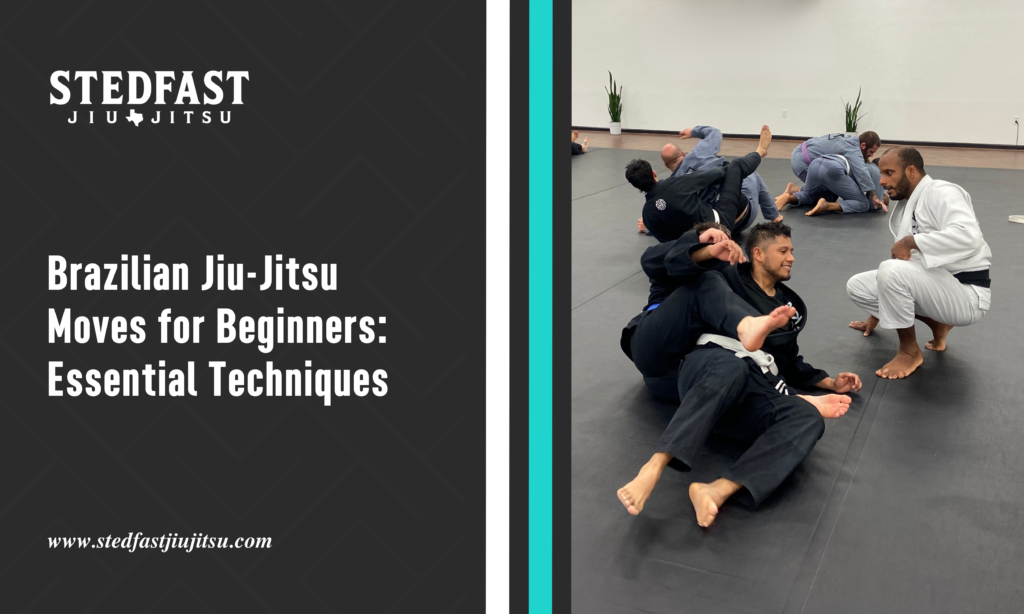
Walking into your first Brazilian Jiu-Jitsu class can feel exciting and confusing at the same time. You may see students moving quickly from one position to another, escaping pressure, controlling their partners, and using techniques that seem difficult to follow. For a beginner, it can feel like there is a lot to learn.
The good news is that no one is expected to understand everything on the first day. Jiu-Jitsu is built one movement at a time. Before students worry about advanced submissions or complicated combinations, they learn how to move safely, protect themselves, stay balanced, and remain calm when a position becomes uncomfortable.
At Stedfast School of Jiu-Jitsu, beginners are encouraged to focus on these fundamentals first. Whether someone joins adults Jiu-Jitsu or begins through kids Jiu-Jitsu, the goal is not to rush through techniques. It is to build a strong foundation that makes every future skill easier to understand.
These basic Brazilian Jiu-Jitsu moves may look simple, but they teach some of the most important lessons students will carry throughout their training.
Learning How to Move Before Learning How to Win
One of the biggest mistakes beginners can make is thinking Jiu-Jitsu is mainly about submissions. Submissions are part of the sport, but good Jiu-Jitsu begins much earlier.
A student first needs to understand how their body moves on the mat. They learn how to create space, keep their balance, protect vulnerable positions, and recognize when they are safe or in trouble.
These fundamentals help students stop relying only on strength. Instead of pushing harder every time something feels difficult, they begin to use timing, leverage, and body position.
That change is one of the first moments when Jiu-Jitsu begins to make sense.
The Hip Escape Helps Beginners Create Space
The hip escape, often called shrimping, is one of the first movements many beginners practice.
The movement teaches students how to move their hips away from pressure instead of trying to push another person away with their arms. This becomes useful in many situations, especially when escaping from underneath a training partner.
At first, the movement can feel awkward. Students may wonder why they are repeating something that looks so simple. Over time, they realize the hip escape appears everywhere in Jiu-Jitsu.
It teaches an important lesson: when someone is applying pressure, the answer is not always to fight harder. Sometimes creating a little space is enough to change the entire position.
Bridging Teaches Students How to Use Their Whole Body
The bridge is another basic movement that beginners practice early.
While lying on the mat, students use their feet, hips, and core to lift and shift their body. This can help disturb a partner’s balance and create an opportunity to escape.
Beginners often try to solve problems with their arms because that feels natural. Bridging teaches them to use the stronger parts of their body instead.
This helps students understand one of the central ideas of Jiu-Jitsu: good technique connects the entire body.
A smaller student does not need to rely only on upper-body strength. By learning how to use the hips, legs, and correct angles, they can become much more effective while using less energy.
Frames Help Beginners Stay Calm Under Pressure
Being underneath another person can feel uncomfortable when you are new to Jiu-Jitsu. The natural reaction is often to push, tense up, and try to escape as quickly as possible.
Frames help students respond differently.
A frame is a strong body structure that helps maintain space between two people. Instead of trying to hold someone’s weight away with muscle alone, students learn to position their arms and body so they can manage pressure more efficiently.
This can make a major difference for beginners.
They start to realize they do not need to panic simply because someone is above them. They can create structure, breathe, and begin solving the position one step at a time.
That calmness becomes one of the most valuable skills Jiu-Jitsu teaches.
The Technical Stand-Up Builds Balance and Control
Getting back to your feet sounds simple until another person is nearby and movement needs to stay controlled.
The technical stand-up teaches students how to rise from the ground while protecting themselves and maintaining balance.
Rather than turning away or standing carelessly, students learn how to keep space, stay aware, and return to their feet with control.
For beginners, this movement builds coordination and confidence. It also reinforces the idea that small details matter. Where the hands go, where the feet are placed, and how the body is balanced can completely change how safe and effective the movement becomes.
Guard Teaches Beginners That Bottom Position Is Not Helpless
One of the most interesting lessons for new students is learning about guard.
A beginner may assume that being on their back means they are losing. Jiu-Jitsu teaches something different.
From guard, students learn how to use their legs, hips, and grips to control distance and manage another person’s movement. They begin to understand that being underneath someone does not automatically mean they have no options.
This can be a powerful confidence-building lesson, especially for smaller students.
Instead of reacting with fear, they learn to recognize the position, protect themselves, and decide what to do next.
For children in kids Jiu-Jitsu classes, these lessons are introduced gradually so students can learn control, patience, and safe movement at a pace that makes sense for them.
Escaping Mount Builds Confidence Step by Step
Mount is one of the positions that can make beginners feel the most uncomfortable.
When another student is positioned above them, the beginner may initially feel stuck. This is exactly why learning basic mount escapes matters.
Students learn how to protect their arms, keep their body structured, use their hips, and create the movement needed to improve their position.
The bigger lesson is emotional as much as physical.
They learn that feeling stuck does not mean they are truly stuck.
They can breathe. They can think. They can remember what they practiced. Then they can work through the problem one step at a time.
As these small escapes begin to work, confidence grows naturally.
Side Control Teaches Patience Instead of Panic
Side control is another position beginners encounter often.
It can feel heavy, especially when someone has more experience and understands how to apply pressure. New students often want to move immediately, but unnecessary movement can make them tired quickly.
Jiu-Jitsu teaches students to slow down.
They learn how to create frames, protect their space, move their hips, and wait for the right opportunity to escape.
This is where beginners start to understand that Jiu-Jitsu is not about reacting to everything at once.
Sometimes the best decision is to stay calm, understand the position, and make one useful movement instead of five rushed ones.
Breakfalls Help Students Learn to Land Safely
Learning how to fall is just as important as learning how to control someone else.
Breakfalls teach students how to protect themselves when they go to the ground. This becomes especially useful as beginners start learning takedowns or working more from standing positions.
Many people naturally tense up when they think they may fall. Practicing safe falling techniques helps remove some of that fear.
Students become more comfortable with movement because they trust themselves to land properly.
For both children and adults, that confidence can make training feel much safer and more enjoyable.
Learning to Tap Is Part of Learning Jiu-Jitsu
Beginners sometimes worry that tapping means losing. In Jiu-Jitsu, tapping is simply part of safe training.
A tap tells your partner that a position or submission has reached the point where they should stop. Training partners learn to respond immediately and respectfully.
This creates trust on the mat.
Students know they can practice challenging positions because there is a clear way to communicate when they need to stop.
Learning to tap also teaches humility. There will always be techniques you do not understand yet and positions where someone else has more experience. That is not failure. It is part of learning.
The goal of training is not to win every round. It is to leave each round knowing a little more than you did before.
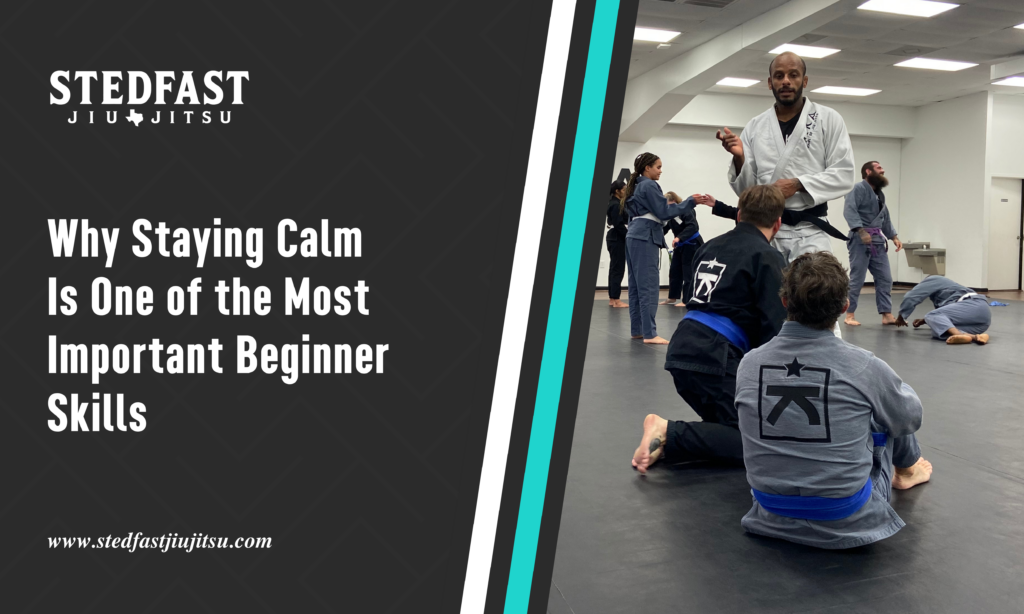
Why Staying Calm Is One of the Most Important Beginner Skills
Most beginners use too much energy at first.
They hold their breath. They grip too hard. They move quickly because they are afraid of getting stuck. After a few minutes, they are exhausted.
With time, they begin to slow down.
They learn to breathe under pressure. They recognize familiar positions. They stop trying to force every movement.
This is where Jiu-Jitsu begins to change from something that feels chaotic into something that feels understandable.
Students realize that they do not need an immediate answer to every problem. They just need to stay calm enough to find the next step.
That lesson reaches far beyond the academy. Learning to stay composed when things feel difficult can help students handle pressure at school, at work, in sports, and in everyday life.
How Stedfast Helps Beginners Build Strong Fundamentals
At Stedfast School of Jiu-Jitsu, beginners are given time to learn without feeling pressured to keep up with more experienced students. Classes focus on safety, clear instruction, respect, and steady improvement. Students are encouraged to ask questions, learn from mistakes, and build confidence one technique at a time.
Good Jiu-Jitsu Starts With the Basics
Beginners do not need to memorize dozens of techniques during their first few weeks.
Learning how to move your hips, bridge, create frames, understand guard, escape difficult positions, fall safely, and tap when necessary creates a much stronger foundation than rushing toward advanced techniques.
These movements teach more than physical skills. They teach patience, control, awareness, and the confidence to stay calm when something feels difficult.
At first, every position may feel unfamiliar. After consistent training, patterns begin to appear. Students recognize where they are, understand where they need to go, and start solving problems with less effort.
That progress does not happen all at once. It grows through small moments on the mat.
One escape becomes easier. One movement feels more natural. One difficult position no longer creates panic.
For adults and families in Sugar Land and Missouri City who are curious about Brazilian Jiu-Jitsu, there is no need to know these techniques before stepping into class. That is what training is for.
If you or your child are ready to begin learning in a safe and supportive environment, contact Stedfast School of Jiu-Jitsu and take the first step onto the mat.
Learn the basics. Build confidence. Keep showing up. The rest grows from there.

by Adele | Sep 10, 2026 | Brazilian Jiu-Jitsu
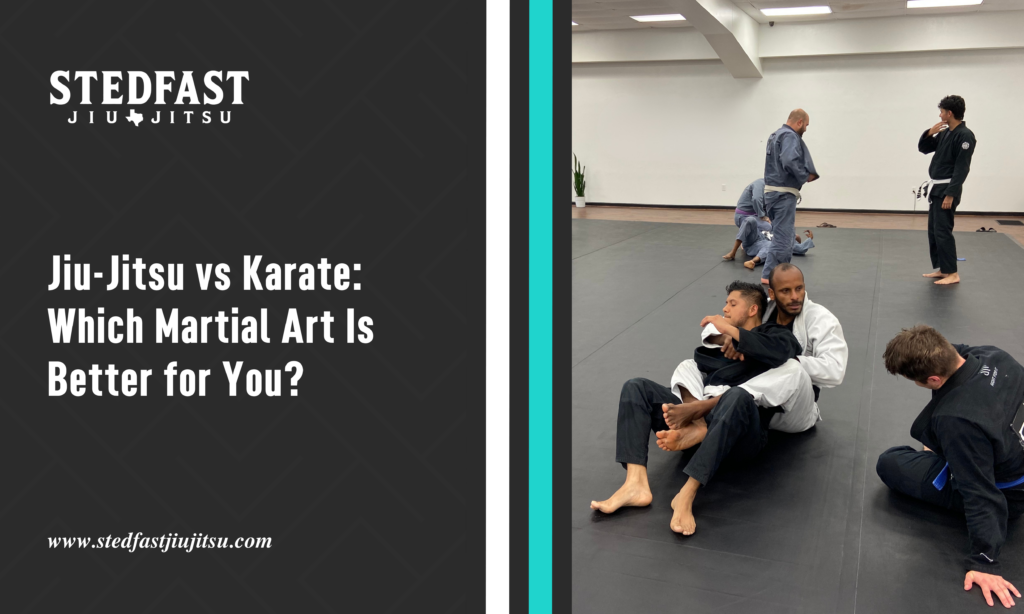
Choosing a martial art is not always as simple as picking the one that looks the most exciting. Parents may be looking for an activity that builds confidence and discipline in their child, while adults may want practical self-defense, better fitness, stress relief, or a new challenge.
Jiu-Jitsu and Karate are two of the most well-known martial arts, and both have a lot to offer. They can improve coordination, focus, confidence, and physical fitness, but the way students train is very different.
Understanding those differences can make it easier to decide which martial art fits your personality, goals, and preferred way of learning.
The Main Difference Between Jiu-Jitsu and Karate
The biggest difference is the type of movement each martial art focuses on.
Karate is primarily a striking martial art. Students commonly practice punches, kicks, blocks, footwork, and combinations. Many styles also include kata, which are structured sequences of movements that help students develop coordination, balance, timing, and technique.
Brazilian Jiu-Jitsu is centered around grappling. Students learn how to control another person, escape difficult positions, maintain balance, use leverage, and defend themselves when physical contact becomes close.
In adults Jiu-Jitsu classes, students spend a lot of time learning how to stay calm when someone is applying pressure or trying to improve their position.
Instead of relying mainly on punches or kicks, the focus is on positioning, timing, technique, and control.
Karate Builds Striking Skills and Distance Control
Karate can be an excellent choice for people who enjoy fast movements and structured technique.
Students learn how to move in and out of range, deliver strikes with control, and react quickly. Repetition plays an important role, helping movements become smoother and more precise over time.
For some students, this structure is very rewarding. They enjoy practicing combinations, improving their form, and seeing how small technical adjustments make their movements sharper.
Karate may especially appeal to someone who wants to focus on stand-up striking and prefers training that involves more distance between partners.
Jiu-Jitsu Turns Training Into Problem-Solving
Jiu-Jitsu feels very different because another person is constantly affecting what happens next.
A student may understand exactly what technique they want to use, but their training partner is moving, adjusting their weight, changing position, and trying to solve the same problem from the other side.
This means students are always thinking.
They learn how to create space, protect themselves, maintain balance, recognize opportunities, and choose the safest next move.
For children in kids Jiu-Jitsu classes, that problem-solving can help develop patience and focus. They begin to understand that rushing is not always the answer. Sometimes slowing down, thinking, and making a small adjustment works better.
That lesson can carry into school, sports, and everyday challenges.
Which Martial Art Builds More Confidence?
Both Karate and Jiu-Jitsu can help students become more confident.
In Karate, confidence can develop as students improve their kicks, punches, balance, and forms. Learning new skills and progressing through ranks gives students clear evidence that their work is paying off.
Jiu-Jitsu builds confidence through a different kind of experience.
Students regularly find themselves in positions that initially feel difficult. Someone may be controlling them from the top, blocking an escape, or making them work harder than expected.
Over time, they learn not to panic.
They breathe, remember what they have practiced, and start solving the situation step by step.
That creates a quiet kind of confidence. Students begin to understand that being uncomfortable does not mean they are helpless.
They can stay calm and keep working.
Jiu-Jitsu vs Karate for Kids
For parents, the best choice often depends on the child.
Some children enjoy the repetition and structure of Karate. They like practicing techniques individually, working on forms, and improving their coordination through repeated movement.
Other children prefer a more interactive environment.
Jiu-Jitsu gives kids constant opportunities to work with partners, solve problems, and learn how to manage physical contact safely.
At the younger level, Little Kids Jiu-Jitsu introduces those ideas in a way that matches a child’s age and attention span.
Students learn how to listen, follow instructions, respect their training partners, and control their movements.
The goal is not to make children aggressive. It is to help them become more confident, disciplined, and comfortable handling challenges.
Which One Is Better for Self-Defense?
Self-defense is one of the biggest reasons people begin martial arts.
Karate teaches striking skills that can help someone understand distance, movement, and how to respond while standing.
Jiu-Jitsu focuses more heavily on situations where someone grabs, holds, tackles, or controls another person.
This can be valuable because real-life physical conflicts do not always stay at a comfortable striking distance.
Jiu-Jitsu students spend time learning how to protect themselves from difficult positions, escape pressure, and control another person without depending entirely on strength.
No martial art can guarantee safety, and avoiding conflict should always come first. However, practicing techniques against a resisting partner can help students understand what pressure and movement actually feel like.
That experience can make it easier to remain calm instead of freezing.
Fitness Looks Different in Each Martial Art
Both Jiu-Jitsu and Karate can provide a strong physical workout.
Karate can improve cardiovascular fitness, speed, balance, coordination, and flexibility through repeated striking and movement drills.
Jiu-Jitsu challenges the body in another way.
Students are constantly changing position, using their core, adjusting balance, moving their hips, controlling posture, and working against another person’s resistance.
The result is a workout that involves almost the entire body.
Many adults enjoy Jiu-Jitsu because they are so focused on learning that they stop thinking about the workout itself.
You are trying to understand a position or escape rather than counting repetitions.
By the end of class, you still know you worked hard.
Discipline and Respect Matter in Both
One thing Jiu-Jitsu and Karate have in common is the importance of discipline.
Progress takes time.
Students have to listen, practice, repeat techniques, accept mistakes, and keep showing up even when improvement feels slow.
Both martial arts also teach respect for instructors and training partners.
In Jiu-Jitsu, that respect is especially important because students work so closely with one another. They learn when to slow down, how to tap safely, when to stop, and how to help a partner learn without turning every round into a competition.
That creates responsibility.
Students begin to understand that good training is not only about what they can do. It is also about how they treat the person training with them.
The Right Academy Matters as Much as the Martial Art
A martial art can only be as positive as the environment where it is taught.
Some students thrive in highly competitive settings. Others need an academy where they can learn gradually without feeling pressured to prove themselves.
Parents should pay attention to how instructors communicate with children, how safety is handled, and how experienced students treat beginners.
Adults should look for the same things.
A good martial arts school should make students feel challenged without making them feel unsafe or unwelcome.
The right culture can make the difference between training for a few weeks and building a habit that lasts for years.
How Stedfast Approaches Jiu-Jitsu Training
At Stedfast School of Jiu-Jitsu, training is built around safety, respect, patience, and steady improvement.
Students are encouraged to learn at their own pace, work with their training partners rather than against them, and focus on becoming more confident and capable over time.
Which Martial Art Matches Your Personality?
Sometimes the easiest way to choose is to think about what you enjoy.
Karate may be a better fit if you like:
- Punches, kicks, and stand-up movement
- Structured repetition and forms
- Working on speed, timing, and distance
Jiu-Jitsu may appeal more if you enjoy:
- Problem-solving and strategy
- Working closely with a training partner
- Learning through live resistance
- Grappling, control, and escapes
Neither list makes one martial art better than the other.
They simply offer different ways to learn.
Finding the Right Martial Art for You
Jiu-Jitsu and Karate can both teach lessons that go far beyond physical technique.
They can build discipline, confidence, body awareness, patience, and respect.
The better choice depends on what you want from training.
If you enjoy striking, movement, forms, and learning how to manage distance, Karate may be a strong fit.
If you are interested in grappling, problem-solving, body control, and learning how to stay calm under pressure, Jiu-Jitsu may feel more natural.
For families and adults in Sugar Land and Missouri City, the best way to understand that difference is to experience training for yourself.
You do not need previous martial arts experience, and you do not need to be in perfect shape before starting.
If Jiu-Jitsu sounds like the right direction for you or your child, contact Stedfast School of Jiu-Jitsu and step onto the mat.
Sometimes the best martial art is simply the one that keeps you learning, growing, and wanting to come back.